 |
||||
|
Recently as I was talking with an executive about succession management in his industry, the conversation turned to his own situation. Although he had retired several years earlier, he chose to return to the profession he loves because he felt (and still feels) he has important contributions to make. Now, however, he is faced with an unwelcome reality: physical ailments are constraining his ability to continue leading his department well. Can you relate to this executive’s dilemma? Perhaps the physiological stress of the job is more than you or someone you know are willing to tolerate, or your family has become a higher priority, or the job just isn’t fun anymore. Even though your passion for your profession or cause remains, your heart just isn’t in your job. It’s time to move on. Except you can’t bring yourself to do it. Instead, you convince yourself that you are indispensable, or that no one can run the department as well as you, or the same way that you do. So you double down, determined to “make it work.” How’s that tactic working for you? How’s it working for your family, your employees, and your customers? Most human beings find change scary, so resisting it comes naturally to us. Especially when you’ve devoted your entire life to your career, you can’t imagine doing something different. Even when you know you’re no longer the best person for your current job, and in fact your employees and/or your organization may be suffering as a result, you resist moving on. If this situation describes you, or someone you know, here are four tools that can help you move on to your next chapter. Tool #1: Adjust your mindset Tool #2: Ask and answer truthfully this question: “Am I the only person in the world who can do this job?” Tool #3: Consider the impact of your choice on your employees, colleagues, and customers Tool #4: Identify alternative ways you can honor your passion or cause If you’d like to learn more about how to prepare for your next chapter – whether it’s retirement, another organization, another role, or another career – take a look at our article What’s Your Personal Succession Planning Process? To find other articles and resources that may be of value to you, I invite you to visit my web site at www.BusinessAlignmentStrategies.com and my blog at www.OptimizeBusinessResults.com Alignment Solutions is a concise, bi-weekly newsletter written specifically to help organizational leaders optimize their business results. Your e-mail address is never shared with anyone for any reason. You may unsubscribe by clicking the link on the bottom of this e-mail.
|
||||

© 2016 Pat Lynch. All rights reserved. |

Alignment Solutions Newsletter: How to Stop the Insanity of Unproductive Conversations
August 24th, 2016 |
||||
|
Have you ever had the same conversation over and over again because an undesirable behavior or outcome failed to change? Perhaps it’s with an employee who consistently misses deadlines, promises to do better, then continues to be late. Maybe the conversation is with your kids when they don’t do their chores (again). The good news: you can stop this vicious cycle today by making a few simple changes. One of my presentations last week at an international fire chiefs’ conference was called “Stop the Insanity of Public Safety Conversations: Change the Context.” In it I offered four simple techniques to help change unproductive conversations to productive ones – i.e., those that change an undesirable status quo. Although I can’t guarantee that you always will get the outcome you want, I can say they will get you out of the unproductive rut in which you find yourself. Bonus: the techniques work both inside and outside any kind of workplace. Technique #1: Ask positive questions Sample scenario: A project for a major client goes terribly wrong. Which set of questions is more likely to enable your team to devise a productive solution to ensure it doesn’t happen again?
Technique #2: Change the question Sample scenario: Executives at a retail store known for its exceptional customer service must cut costs. Which question is more likely to result in a thoughtful conversation about how to ensure the store retains its stellar reputation with customers?
Technique #3: Change the context or focus Sample scenario: Despite all their training and discussions of why safety is important, some employees at a manufacturing plant still take shortcuts that jeopardize their safety. Which area of focus is more likely to result in a conversation that changes that behavior?
Technique #4: Change the level of the conversation Sample scenario: A department manager consistently misses scheduled meetings with his employees, causing them to make embarrassing mistakes due to the delay in conveying important product information. Which example below is more likely to correct this undesirable behavior?
Note: sometimes having the “content” level of conversation is enough to get the desired behavior; other times it’s necessary to have the “commitment” level of conversation. My experience is that it seldom is necessary to escalate the conversation to the “relationship” level. Each of the four techniques described above can save you from the insanity of unproductive conversations. Choose the one that’s most relevant to the situation at hand. While it may not get you everything you want, at minimum it will result in a more productive use of your time and better results than you have experienced. If you’d like to learn more about the benefits of using positive language, take a look at our article The Transformative Power of Appreciative Language. To find other articles and resources that may be of value to you, I invite you to visit my web site at www.BusinessAlignmentStrategies.com and my blog at www.OptimizeBusinessResults.com Alignment Solutions is a concise, bi-weekly newsletter written specifically to help organizational leaders optimize their business results. Your e-mail address is never shared with anyone for any reason. You may unsubscribe by clicking the link on the bottom of this e-mail.
|
||||
|
© 2016 Pat Lynch. All rights reserved. |
Alignment Solutions Newsletter: How Healthy is Your Retention Process?
July 20th, 2016 |
||||
|
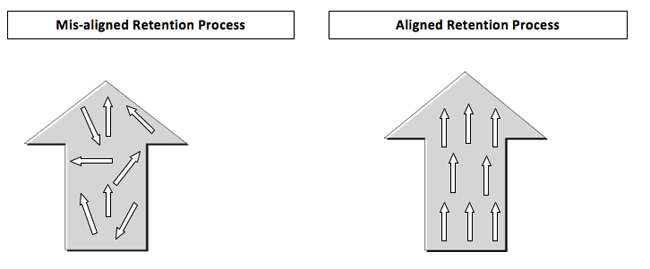
I define “healthy retention” as an organization’s ability to retain good performers long-term and to release poor performers as soon as the lack of fit becomes evident and cannot be remedied effectively. A healthy retention process begins before the preparation of job- and organization- based recruitment materials, and it continues throughout each person’s career. While leaders often do a very good job of addressing some – or perhaps many – elements of the retention process, their misalignment with the goal of healthy retention is an obstacle to a successful process. In the images below, the big arrows represent the direction of a healthy retention process; the small arrows represent very good programs, practices, processes, and systems that comprise a healthy retention process. As you can see, even really good elements of a process cannot succeed when they are at odds with each other. A healthy retention process requires the alignment of all its elements.
There are three major controllable reasons for unhealthy retention processes. Leaders:
Below are suggested remedies for increasing the health of your retention process. Problem #1: failure to distinguish between healthy and unhealthy retention Remedy: clearly define what “healthy retention” means for your organization. Assess your current status. Identify the gaps between where you are and where you’d like to be. Take action to address those gaps. Problem #2: take a very narrow view of what elements comprise a healthy retention process Remedy: take an expansive view of retention. Recognize that healthy retention begins with purposeful preparation, includes recruitment, selection, orientation, and probationary period, and continues with employees’ workplace experiences throughout their careers. Develop your healthy retention process accordingly. Problem #3: view and treat retention as a task instead of as a systematic, on-going process Remedy: identify all the elements of a healthy retention process. Connect the dots among them so they complement each other and accelerate progress toward achieving organizational goals instead of obstructing or duplicating one another. Turnover is extremely expensive for organizations, requiring extensive direct and indirect costs as well as disrupting operations and reducing productivity. Would you rather cut corners in your retention process and pay the resultant high price, or would you prefer to invest in developing and retaining a high performance workforce that gets better over time as its positive reputation attracts the best candidates?
Are you curious about the extent to which your organization’s retention process is healthy? Take a look at our Healthy Retention Self-assessment. To find other articles and resources that may be of value to you, I invite you to visit my web site at www.BusinessAlignmentStrategies.com and my blog at www.OptimizeBusinessResults.com Alignment Solutions is a concise, bi-weekly newsletter written specifically to help organizational leaders optimize their business results. Your e-mail address is never shared with anyone for any reason. You may unsubscribe by clicking the link on the bottom of this e-mail.
|
||||
|
© 2016 Pat Lynch. All rights reserved. |
Alignment Solutions Newsletter: How to Increase the Likelihood of a Good Person-Job-Organization Fit
June 29th, 2016 |
||||
|
One often unrecognized fact about hiring and promotional processes is that a job interview is a two-way evaluation. That is, the candidates as well as the employer have the opportunity to assess the goodness-of-fit between themselves, the job, and the organization. In order for both sides to make informed decisions, however, the employer must provide all relevant information, both positive and negative. To do otherwise would be a disservice to all stakeholders as well as to the organization. If asked why they decline to mention the down sides to a given job, most employers say they don’t want to scare off good candidates. I’ve got news for them: they’re going to lose new hires who discover their expectations will not be met. On the other hand, new hires who are poor fits are likely to stay, causing negative repercussions throughout the organization. Acknowledging the lack of fit earlier in the selection process rather than later will save you money and time, as well as avoid the costs associated with reduced productivity and employee morale, and unhappy customers. Here are eleven actions you can take to provide candidates for hire and/or promotion with a realistic job preview: Before the interview:
During the interview:
After the interview:
While no one likes to lose otherwise good job candidates, hiring or promoting someone who is a poor fit for the job and/or the organization does a disservice to everyone. Who would you rather have serving your customers: people who went into the job with realistic expectations or those who are disillusioned because their expectations were not met? To find other articles and resources that may be of value to you, I invite you to visit my web site at www.BusinessAlignmentStrategies.com and my blog at www.OptimizeBusinessResults.com. Alignment Solutions is a concise, bi-weekly newsletter written specifically to help organizational leaders optimize their business results. Your e-mail address is never shared with anyone for any reason. You may unsubscribe by clicking the link on the bottom of this e-mail.
|
||||
|
© 2016 Pat Lynch. All rights reserved. |
Alignment Solutions Newsletter: Timing is Everything
June 1st, 2016 |
||||
|
Timing is Everything
Years ago I was hired by a large fire and rescue agency to salvage a critical project that was well outside its members’ areas of expertise. With a mess on its hands despite weeks of frantic efforts to handle the issue internally, and with a deadline fast approaching, the agency finally called an expert. Asked why it took so long to seek the help they knew they needed, a fire captain replied, “When faced with any problem, we always do something. Even when we don’t know what we’re doing, we still do something because we’re the fire department and people expect us to handle whatever comes up.” If you’ve ever attended a public safety educational event, you know that first responders tell people to call 911 in an emergency. “Even if you’re not sure whether the situation truly requires a fire, EMS, or law enforcement response,” they advise, “call us anyway. We’re the experts; let us decide.” Given those clear and simple instructions, why do some people insist on trying to handle an emergency themselves before calling 911? Perhaps this scenario sounds familiar: although you are well trained in your field, you’ve been asked to achieve a goal or provide a deliverable outside that area of expertise, and for which you have had no training or preparation. Perhaps you must develop a department strategy, or create a new process or system, or resolve a difficult workplace situation. Even though you don’t know where to begin, you opt to give it your best shot rather than ask for help. After all, how hard could it be? (Note: for your own good, don’t ever pose this query as a rhetorical question.) Although these situations seldom involve danger to life or property, delaying a request for assistance is likely to result in significant costs and/or a failure to deliver a key outcome. Next time you find yourself in a situation in which you’re required to do something that’s beyond your area of expertise, ask yourself this question: “Is there anyone else in the world who knows how to do [the task at hand]?” In the rare case in which the answer is “No,” then take it on yourself. However, when the answer is “Yes,” call an internal or external expert. And when calculating your return on investment, don’t forget to include the peace of mind that comes from knowing that a key outcome will be achieved successfully and on time. Because even though you are not the fire department, people expect you to know what to do. To find other articles and resources that may be of value to you, I invite you to visit my web site at www.BusinessAlignmentStrategies.com and my blog at www.OptimizeBusinessResults.com. Alignment Solutions is a concise, bi-weekly newsletter written specifically to help organizational leaders optimize their business results. Your e-mail address is never shared with anyone for any reason. You may unsubscribe by clicking the link on the bottom of this e-mail.
|
||||
|
© 2016 Pat Lynch. All rights reserved. |
Alignment Solutions Newsletter: How Are You Building Your Legacy?
May 11th, 2016 |
||||
|
How Are You Building Your Legacy?
Some legacies arise from a game-changing invention or innovation, or a life-saving discovery, or an inspiring life of service. Most, however, are built on everyday actions, decisions, and choices that leave the world a better place. As Mother Teresa said, “Not all of us can do great things. But we can do small things with great love.” My brother Peter describes himself on his Facebook page as “a man of few talents, many moods, light-hearted, deadly serious, kind to animals.” Those words don’t begin to hint at the legacy that he is creating. During the last ten years, for example, he was the neighborhood “Grampy,” spending hours talking with, teaching, and mentoring kids who learned they could trust him to help them navigate the choppy waters of childhood and the teenage years. I can only imagine the impact his attention and encouragement will have as they grow up. Here are twenty suggestions for building a positive legacy by leaving the world a better place than you found it. These techniques work both in and outside of the workplace.
What will be your legacy? What will you do today to make the world a better place than it was when you arrived? To find other articles and resources that may be of value to you, I invite you to visit my web site at www.BusinessAlignmentStrategies.com and my blog at www.OptimizeBusinessResults.com. Alignment Solutions is a concise, bi-weekly newsletter written specifically to help organizational leaders optimize their business results. Your e-mail address is never shared with anyone for any reason. You may unsubscribe by clicking the link on the bottom of this e-mail.
|
||||
|
© 2016 Pat Lynch. All rights reserved. |
Alignment Solutions Newsletter: For Successful Strategy Implementation, Follow a Recipe
April 8th, 2016
|
||||||||||||
|
For Successful Strategy Implementation,
As my senior year in college wound down, it occurred to me that I ought to get serious about learning how to cook. Although I like a lot of different kinds of food, once a meal required more than putting something between two slices of bread or following the instructions on a box or can that went beyond “Add water and stir,” my lack of interest in the culinary arts had left me dependent on the kindness of others. While I understood WHAT I wanted (good, inexpensive home cooked meals), I was clueless about HOW to achieve that outcome. Fortunately during a trip to the campus bookstore, a promising title caught my eye: The Campus Survival Cookbook. Opening the book to a random recipe, the first step told me immediately that the authors had me in mind when they wrote it: “Turn on the oven to 350 degrees. Close the door.” How often have you been given responsibility for achieving an outcome and not had a clue about how to pull it off? Trial and error is one way of learning. However, the costs of taking this approach often outweigh its benefits. Yet the “hit or miss” option often is the default method when it comes to creating a strategic plan. Here’s a common scenario: leaders write a strategic plan and tell their subordinates to make it happen. Some even may write an action plan to accompany the strategy. Yet somehow the goals never are achieved. “Strategies fail in their implementation” is true. The world’s best written strategic plan is a failure if it winds up in a drawer or on a shelf (or merely published on the web site). It does nothing to help move the organization forward or serve its customers better. To dramatically increase the likelihood of achieving the goals in their strategic plans, I advise my clients to write an implementation plan vs. an action plan. Here are three major differences between these two approaches:
Although taking the “recipe” approach is key to a successful strategy implementation, it does present some challenges. Due to the required level of detail, for example, creating it is very labor intensive. In addition, few people have the necessary expertise to do a good job. Yet there are tools available to help mitigate these challenges and successfully implement your strategy. What’s it worth to you and your customers to enable your organization to provide the best possible service or products effectively and efficiently? What’s the cost of NOT doing so? If you’d like to see an example of an implementation plan, go to my web site and request an example of what a template for implementing part of a mentor program looks like. (Scroll down to Fire-Rescue International 2014 conference, handout #2.) To find other articles and resources that may be of value to you, I invite you to visit my web site at www.BusinessAlignmentStrategies.com and my blog at www.OptimizeBusinessResults.com. Alignment Solutions is a concise, bi-weekly newsletter written specifically to help organizational leaders optimize their business results. Your e-mail address is never shared with anyone for any reason. You may unsubscribe by clicking the link on the bottom of this e-mail.
|
||||||||||||
|
© 2016 Pat Lynch. All rights reserved. |
Alignment Solutions Newsletter: Workplace Socialization Insights from a Local Animal Shelter
March 23rd, 2016 |
||||
|
Workplace Socialization Insights
Recently I adopted a nine-month old cat from a local animal shelter. He’d had a rough start in life, which made him very distrustful of people and fearful of new surroundings. As I was getting ready to take him home, one of the dedicated shelter volunteers offered this advice: “Everything will be new to him. He doesn’t know you, or where things are, or who he can trust. He doesn’t know yet that he shouldn’t chew on electrical cords. Be very patient with him. Let him settle in at his own pace. Create a safe space for him as he gets to know his new surroundings and family. Soon the things that are new now will become as ordinary to him as they are to you.” This advice is just as sound for people as it is for pets. When you have new employees – whether they’re starting their first job or have years of experience – they are entering unfamiliar terrain. They are anxious to learn the ropes and fit in so they can contribute. It’s the leader’s job to socialize these folks to the workplace – i.e., teach them how things are done here. The more supportive you and other employees are, the faster the new people will be able to integrate themselves into the team and be productive. Here are four ways to help accelerate the socialization process and make it as smooth as possible:
The way that you bring people into a new organization or team sets the stage for their subsequent success or failure. The socialization process plays a huge role in employees’ decisions about whether and how long to stay with the organization. By taking the newcomers’ perspectives, communicating reasonable expectations and providing the support needed to meet or exceed them, and being prepared for possible stormy weather, you can accelerate the socialization process and greatly influence their experience on the new job. You’ve already invested in these individuals. Why not protect that investment by setting them up for success? To find other articles and resources that may be of value to you, I invite you to visit my web site at www.BusinessAlignmentStrategies.com and my blog at www.OptimizeBusinessResults.com. Alignment Solutions is a concise, bi-weekly newsletter written specifically to help organizational leaders optimize their business results. Your e-mail address is never shared with anyone for any reason. You may unsubscribe by clicking the link on the bottom of this e-mail.
|
||||
|
© 2016 Pat Lynch. All rights reserved. |
Alignment Solutions Newsletter: How to Gain Buy-in Despite Resistance
February 24th, 2016 |
||||
|
How to Gain Buy-in Despite Resistance
Human beings seem hard-wired to resist change, even when we believe the promised outcome will be positive. In the late 1980s, for example, when CEO Fred Smith declared that FedEx would become the first service company to win the prestigious Malcolm Baldrige Excellence Award, I didn’t hear of a single employee who was anything but enthusiastic about this goal. That is, until we found out that it required US to change how we worked. Suddenly the status quo looked a lot more attractive to us. Like other organizations, public safety agencies are subject to stakeholders’ resistance to change. However, Fire Chief Kingman Schuldt has developed a process that has enabled the Greater Naples Fire and Rescue District to overcome successfully the objections by a variety of stakeholders to a number of initiatives. As a result, the agency has been successful in consolidating multiple independent fire districts as well as developing and implementing an organizational strategy, an employee performance system, and a customer satisfaction survey program. Here are the steps in that process:
By following the above process, over time, your organization can establish a culture that takes a positive approach to all issues, not just those at the strategic level. Such a culture can result in increased employee morale, greater productivity, and delighted customers. Why not make that investment in your organization? If you’d like details about the above process and some examples of how it works, take a look at my article Using a Positive Approach to Gain Buy-in from Resistant Stakeholders. To find other articles and resources that may be of value to you, I invite you to visit my web site at www.BusinessAlignmentStrategies.com and my blog at www.OptimizeBusinessResults.com.
|
||||
|
© 2016 Pat Lynch. All rights reserved. |
Alignment Solutions Newsletter: Tips for Creating Meaningful Measures
February 10th, 2016 |
||||
|
Tips for Creating Meaningful Measures
By “meaningful measures” I mean indicators that demonstrate performance and/or outcomes clearly to the target audience. For example, in a strategy, measures reveal to stakeholders the progress toward, and achievement of, organizational goals. In an annual report, they demonstrate the value you provide your customers. In a performance management process, metrics enable you to assess employees’ efforts. Unfortunately, “metrics” or “measure” is a word that can intimidate even the most accomplished leaders. Although measures are an indispensable leadership tool, the reality is that developing meaningful indicators can be challenging. Here are nine suggestions to help make that process easier for you.
If you’d like more information about how to create meaningful measures, take a look at my article Solutions to the 5 Most Common Measurement Mistakes. To find other articles and resources that may be of value to you, I invite you to visit my web site at www.BusinessAlignmentStrategies.com and my blog at www.OptimizeBusinessResults.com.
|
||||
|
© 2016 Pat Lynch. All rights reserved. |